BrIAS Thursday Seminars: BIFD Tània Verge & BIFD Katerina Rashkova
- When
- Europe/Brussels (GMT+2)
- Where
- The Brussels Institute for Advanced StudiesBoulevard Général Jacques 210, 1050 Ixelles
Tickets are sold on Eventbrite. We link straight to the listing — nothing is bought here. Listing details come from the source and can change. Eventovia indexes events; it does not organize them or sell tickets. Terms & Disclaimer
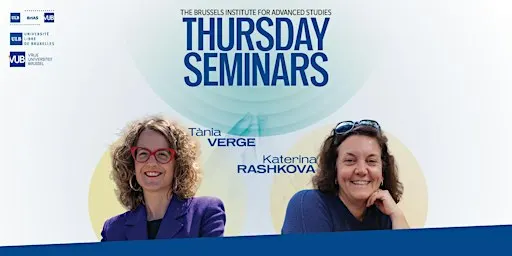
BrIAS Thursday Seminars: BIFD Tània Verge & BIFD Katerina Rashkova takes place on Thu, 22 Apr 2027 at 12:00 (GMT+2) at The Brussels Institute for Advanced Studies in Brussels, Belgium. Entry is free; the listing is on Eventbrite.
About this event
Tània Verge presents feminist policies for men while Ekaterina Rashkova discusses political parties mobilizing migrant voters at the BrIAS Thursday Seminars in the Polina Mendeléef Seminar Hall.
Full description from organizerShow less
Explore feminist policies for men, challenges to the far right, and how political parties mobilize migrant and diaspora voters. Challenging Patriarchy while Countering the Far Right: The Case for Feminist Policies for Men by Tània Verge Gender equality policies have historically focused on women, for good reason: gender structures inequalities and power relations that systematically advantage men. When addressing men, gender equality policies have tended to approach them primarily as agents of change, exhorting them to become allies or equality ambassadors, embrace care, reject violence, and, more generally, adopt more egalitarian masculinities. Yet such approaches have clear limitations. Attitudes are unlikely to change simply because policy targets attitudes directly, particularly in an increasingly reactionary political context. This lecture makes the case for feminist policies for men, without embracing narratives of male victimhood. By feminist policies for men, I mean policies that address the gendered conditions shaping men’s lives, ranging from educational underachievement and the marked underrepresentation in care professions to specific health risks or the invisibility of male victims of sexual violence. Acknowledging men’s structural privilege does not preclude recognising situated disadvantages affecting men and boys, nor addressing them through concrete policy measures, including positive action. Rather than seeking to transform masculinities primarily through interventions aimed at changing attitudes, feminist policies for men should intervene in the material and institutional conditions through which attitudes, behaviours and gender relations are (re)produced, thereby bearing more potential for structural transformation. In doing so, feminist policy can challenge patriarchy while also contesting anti-feminist and far-right actors who turn men’s (gendered) problems into grievances against women, feminism and LGBTIQ+ people. BioTània Verge is a Full Professor of Politics and Gender at the Department of Political and Social Sciences, Universitat Pompeu Fabra (UPF, Barcelona), where she led the Equality Unit between 2014 and 2021 and coordinated the Minor in Gender Studies. Between May 2021 and August 2024, she served as Minister of Equality and Feminisms of the Government of Catalonia, and between May 2024 and February 2026 she was an MP in the Parliament of Catalonia. Her main area of research is gender and politics, with a focus on how political parties and parliaments are shaped by gender dynamics and on resistance to the adoption and implementation of equalities policies. Her consultancy and governmental practice have also given her new insights into the possibilities and limitations of feminist institutional redesign. Exclusive Democracy? The Role of Political Parties in Mobilizing the Migrant Vote by Ekaterina Rashkova Living in an era of mass movement of people – over 300 million people reside elsewhere than their country of birth – it is pertinent to re-address the issues of political participation and representation. Political parties, which originated as the main linking pins between people and government, have largely operated within national grounds. Often, we refer to that link as the one between citizens and government. Yet, in a world of global migration we can no longer think in terms of citizens since with immigrants and emigrants, the electorate has changed beyond nationality and national boundaries. Recent work (e.g. Rashkova and van der Staak 2019) shows that many national parties now engage with their diaspora abroad and claim that migrants' relationship with the receiving state affects their political participation at home (e.g. Chaudary 2018, Finn 2020). At the same time, the evidence on why some parties engage with diaspora while others do not is mixed (e.g. Piccio 2020, Kernalegen and Van Haute 2020). The intention of this talk is to present a snapshot of a research agenda that aims to 1) draw attention to a budding issue of a changing model of representation, 2) provide a brief account of how theoretically political parties respond to migration, and 3) set the scene for a larger scholarly debate on the changing nature of representation due to the changing role and needs of civil society around the globe. BioEkaterina R. Rashkova is a comparative political scientist with expertise on party competition, gender and migrant politics, and representation. Her research interests lie in understanding the behaviour of political actors and the strategies they employ, given the institutional framework and the societal pressure they operate in. Currently, she is working on the representation of migrants and the party abroad. The political integration of non-citizen residents in host countries, as well as the connection of national political parties to their diaspora abroad. Her work often compares new and established democracies and has appeared among others in Comparative European Politics, West European Politics, European Political Science Review, International Political Science Review, Party Politics, and Political Studies as well as in several edited book volumes. How to arrive to BrIAS The event will take place in the Polina Mendeléef Seminar Hall. See the map below for instructions how to arrive to our Seminar hall from Avenue de la Couronne/Kroonlaan.
Keep going
All Brussels events →Similar events
View all →










Details
- When
- Thu, 22 Apr 2027 · 12:00 (GMT+2)
- Where
- The Brussels Institute for Advanced Studies
- Address
- Boulevard Général Jacques 210, 1050 Ixelles
- Price
- Free
- Genre
- 112/seminar or talk
Questions
- When is BrIAS Thursday Seminars: BIFD Tània Verge & BIFD Katerina Rashkova?
- Thu, 22 Apr 2027 at 12:00 GMT+2.
- How much are tickets for BrIAS Thursday Seminars: BIFD Tània Verge & BIFD Katerina Rashkova?
- Entry is free.
- Where is BrIAS Thursday Seminars: BIFD Tània Verge & BIFD Katerina Rashkova?
- The Brussels Institute for Advanced Studies, Boulevard Général Jacques 210, 1050 Ixelles, Brussels, Belgium.
- Where can I buy tickets for BrIAS Thursday Seminars: BIFD Tània Verge & BIFD Katerina Rashkova?
- Tickets are sold on Eventbrite. This page links straight to that listing; no tickets are sold here.