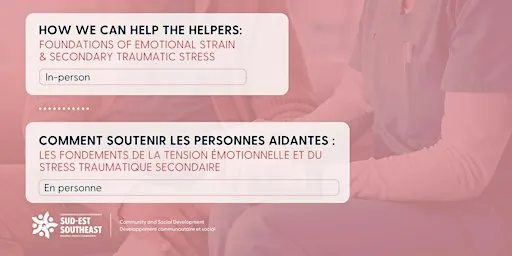
How We Can Help the Helpers / Comment soutenir les personnes aidantes
How We Can Help the Helpers / Comment soutenir les personnes aidantes takes place on Tue, Oct 13, 2026 at 12:00 p.m. (ADT) at Southeast Regional Service Commission in Moncton, Canada. Entry is free; the listing is on Eventbrite.
About this event
This session explores emotional strain and secondary traumatic stress. Participants examine the foundations of these psychological challenges. The event features a presentation on trauma impacts.
Full description from organizerShow less
Foundations of Emotional Strain and Secondary Traumatic Stress/Les fondements de la tension émotionnelle et du stress traumatique secondaire *You are signing up for the online event. / Vous vous inscrivez à l'événement en ligne. le français suivra... Caring for others is deeply meaningful - whether you work in one of many 'caring professions' in your day job, help provide care for a loved one at home, or something else entirely - but often it can also take an invisible toll on us as the demands of that care can sometimes surpass our capacities. Faced with an array of different stressors in the world, the workplace, and our own lives, emotional exhaustion and stress can sneak up on us before we even realize it and the effects of that stress can be severe if left unattended. In this supportive session with facilitator Cory Herc, we will explore the emotional and physical impact of caregiving, and the different ways that stressors can build up in our bodies and minds even when we are not directly receiving that stress. Whether you are a family member caring for a loved one at home, someone working in community and social services, or just someone interested in learning more about emotional stress in a challenging world, this workshop is for you. Together, we will explore: • Recognizing the Signs: Learn how different types of secondary stress, burnout, and emotional fatigue can show up in daily life, and how to identify and distinguish them so that you can start to do something about it earlier. • Understanding Emotional Strain: Make sense of what you are feeling - learning to tell different types of stress apart, and how their effects on us can show up differently depending on where they're coming from, and why. • Practical Tools for Relief: Discover "Low-Impact Debriefing": Learn a practical way to talk through heavy experiences with loved ones or peers without leaving them carrying the weight of it in turn. • Strategies for Everyday Life: Walk away with realistic ways to protect your well-being while continuing to support those who rely on you. Note: While we will talk openly about mental health and stress, discussions will be handled thoughtfully and safely and we won't make mention of any specific troubling experiences. We will keep the environment supportive, uplifting, and clear of unnecessarily heavy trauma details. ------------------ Prendre soin des autres est d’une grande valeur - que vous travailliez dans une profession de la santé ou de l’aide sociale, que vous accompagniez un proche à la maison, ou toute autre situation similaire. Cependant, cette présence constante auprès des autres peut aussi peser lourdement et de façon invisible lorsque les exigences du quotidien dépassent nos capacités. Face aux multiples facteurs de stress du monde d’aujourd’hui, du milieu de travail et de nos vies personnelles, l’épuisement émotionnel peut s’installer à notre insu. Si on n’y porte pas attention, ses effets peuvent devenir graves. Au cours de cette séance bienveillante animée par Cory Herc, nous explorerons les répercussions physiques et émotionnelles du rôle d’aidant, ainsi que les différentes façons dont le stress s’accumule dans le corps et l’esprit, même lorsque nous ne subissons pas directement ces situations traumatisantes. Que vous soyez un membre de la famille prenant soin d’un proche à domicile, une personne travaillant dans le secteur communautaire et social, ou simplement quelqu’un qui souhaite mieux comprendre le stress émotionnel dans un monde complexe, cet atelier s’adresse à vous. Ensemble, nous aborderons : • Reconnaître les signes : Découvrez comment les différents types de stress secondaire, de surmenage (burnout) et de fatigue émotionnelle se manifestent au quotidien. Apprenez à les repérer et à les distinguer afin de pouvoir agir plus tôt. • Comprendre la charge émotionnelle : Mettez des mots sur ce que vous ressentez. Apprenez à différencier les types de stress, à comprendre pourquoi ils se manifestent différemment selon leur origine et comment ils vous affectent. • Des outils pratiques pour soulager le quotidien : Découvrez le « débriefing à faible impact » (Low-Impact Debriefing) : une méthode concrète pour échanger sur des expériences difficiles avec vos proches ou vos pairs, sans leur faire porter le poids de vos confidences. • Des stratégies pour la vie de tous les jours : Repartez avec des moyens réalistes de protéger votre propre bien-être, tout en continuant d’épauler les personnes qui comptent sur vous. Note : Bien que nous abordions ouvertement la santé mentale et le stress, les échanges se dérouleront dans un cadre sécurisant et réfléchi, sans mention d'événements troublants spécifiques. Nous veillerons à maintenir une ambiance soutenante et encourageante, en évitant les détails traumatiques inutilement lourds. ********************************* Facilitator: Cory Herc first came to community development work at age 19, when he was asked to join the Board of Directors of a community organization in Halifax. Without knowing it at the time, something changed inside him, and he began a lifelong journey of systems-change work. Since then, he has lived all across the country, and worked a wide array of jobs - from farmhand to conference director, before calling Southeast New Brunswick home. Living just outside of Moncton, he has proudly been a part of starting three social-purpose non-profits, launched the region’s first Lived Experience Advisory Table on housing and homelessness, and helps communities and organizations develop impactful, human-oriented, and socially-sustainable solutions to the issues that they face. ------------ Cory Herc s’est engagé dans le développement communautaire dès l’âge de 19 ans, lorsqu’il a été invité à siéger au conseil d’administration d’un organisme communautaire à Halifax. Ce qui n’était au départ qu’une opportunité s’est transformé en un engagement de toute une vie envers le changement systémique. Depuis, il a vécu aux quatre coins du pays et occupé une grande diversité de rôles — de travailleur agricole à directeur de conférences — avant de s’établir dans le Sud-Est du Nouveau-Brunswick. Résidant aujourd’hui près de Moncton, Cory a contribué à la création de trois organismes à vocation sociale et a mis sur pied la première table consultative régionale basée sur l’expérience vécue en matière de logement et d’itinérance. Il s’engage à accompagner les communautés et les organisations dans le développement de solutions durables, humaines et à fort impact face aux enjeux qu’elles rencontrent.
Keep going
All Moncton events →Similar events
View all →





Details
- When
- Tue, Oct 13, 2026 · 12:00 p.m. (ADT)
- Where
- Southeast Regional Service Commission
- Address
- 70 Enviro Drive, Berry Mills, NB E1G 5X5
- Price
- Free
- Genre
- 101/seminar or talk
Questions
- When is How We Can Help the Helpers / Comment soutenir les personnes aidantes?
- Tue, Oct 13, 2026 at 12:00 p.m. ADT.
- How much are tickets for How We Can Help the Helpers / Comment soutenir les personnes aidantes?
- Entry is free.
- Where is How We Can Help the Helpers / Comment soutenir les personnes aidantes?
- Southeast Regional Service Commission, 70 Enviro Drive, Berry Mills, NB E1G 5X5, Moncton, Canada.
- Where can I buy tickets for How We Can Help the Helpers / Comment soutenir les personnes aidantes?
- Tickets are sold on Eventbrite. This page links straight to that listing; no tickets are sold here.