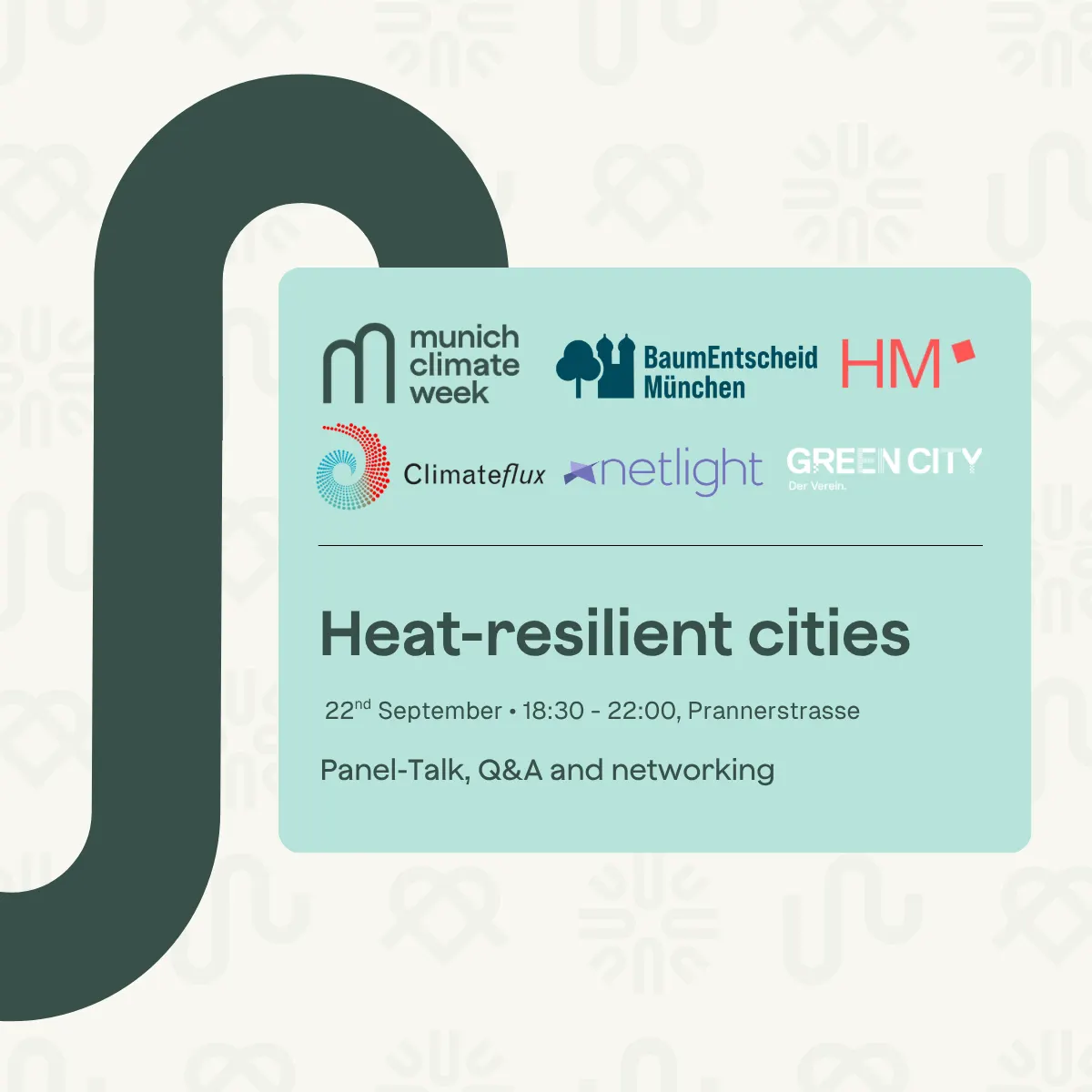
Heat resilience in big cities: How can we adapt?
Heat resilience in big cities: How can we adapt? findet am Di., 22. Sept. 2026 um 18:30 (GMT+2) im Prannerstraße in Munich, Germany, und läuft bis 22:00 statt. Der Eintritt ist kostenlos; der Eintrag befindet sich auf Luma.
Über diese Veranstaltung
Language: English 🌡️ As summers get hotter, urban heat is becoming one of the most pressing climate risks for big cities. But heat doesn't spread evenly across a city and the standard reflex of "just add more air conditioning" only makes things worse, pumping additional heat back into the streets we're trying to cool.
Vollständige Beschreibung lesenWeniger anzeigen
Together with Netlight Consulting, Munich Climate Week is hosting an evening dedicated to making heat resilience tangible: from understanding what heat actually does to buildings and people, to seeing exactly where and why it gets hot, to the concrete changes that make our streets liveable again. Moderated by Bettina von Stamm from UnternehmerTUM, we'll discuss how microclimate data is changing the way we plan our cities, what really works in public space and why, even though many solutions are already well known, implementation still isn't happening fast enough. The panelists: Prof. Dr. Martin Renner (Hochschule München)Martin Renner is a professor at Hochschule München, focusing on ventilation and climate technology, indoor climate, and efficient building cooling. He leads work at the Laboratory for Climate Technology, Indoor Airflow, and Acoustics. Patrick Weiner (Climateflux)Patrick Weiner is an architect and Project Manager at Climateflux, a Munich-based company that uses high-resolution microclimate analyses, simulations, and participatory Climate Walks to make heat visible. Andreas Obermeier (Green City e.V.)Andreas Obermeier is a graduate biologist who has worked at Green City e.V. since 2014, today focusing on education and public space. Green City understands climate adaptation as an interplay of greening, public space, and participation. Magnus Keske (BaumEntscheid München / TUM Think Tank)Magnus Keske is part of the core team behind BaumEntscheid München, a citizen initative for urban street tree policies as a vital tool for climate adaptation and livable neighborhoods. Furthermore, he works at the Urban Digitainability Lab of the TUM Think Tank, where he focuses on sustainable and digital urban development together with administration, science, and civil society Grab a spot on Prannerstraße (concrete location will be communicated separately) and come think out loud with us. After the panel (about an hour) there will be time for a Q&A and networking after! 🌳🌡️
Mehr entdecken
Alle Veranstaltungen in Munich →Ähnliche Veranstaltungen
Alle anzeigen →





Details
- Wann
- Di., 22. Sept. 2026 · 18:30 (GMT+2) · bis 22:00
- Wo
- Prannerstraße
- Adresse
- Prannerstraße, 80333 München-Altstadt-Lehel, Germany
- Preis
- Kostenlos
- Genre
- Social Gatherings
Fragen
- Wann ist Heat resilience in big cities: How can we adapt??
- Di., 22. Sept. 2026 um 18:30 GMT+2.
- Was kosten Tickets für Heat resilience in big cities: How can we adapt??
- Der Eintritt ist kostenlos.
- Wo ist Heat resilience in big cities: How can we adapt??
- Prannerstraße, Prannerstraße, 80333 München-Altstadt-Lehel, Germany, Munich, Germany.
- Wo kann ich Tickets für Heat resilience in big cities: How can we adapt? kaufen?
- Tickets werden auf Luma verkauft. Diese Seite verlinkt direkt zu diesem Eintrag; hier werden keine Tickets verkauft.
- Um wie viel Uhr endet Heat resilience in big cities: How can we adapt??
- Die Veranstaltung läuft bis 22:00.