Why can't a machine do it instead? The Triad™ of Critical, Scientific, and Quantitative Thinking applied to your problem
- Cuándo
- Europe/Madrid (GMT+1)hasta las 14:00
- Dónde
- Barcelona, CTBarcelona, CT
Las entradas se venden en Luma. Enlazamos directamente al evento — aquí no se compra nada. Los detalles del evento proceden de la fuente y pueden cambiar. Eventovia indexa eventos; no los organiza ni vende entradas. Términos y aviso legal
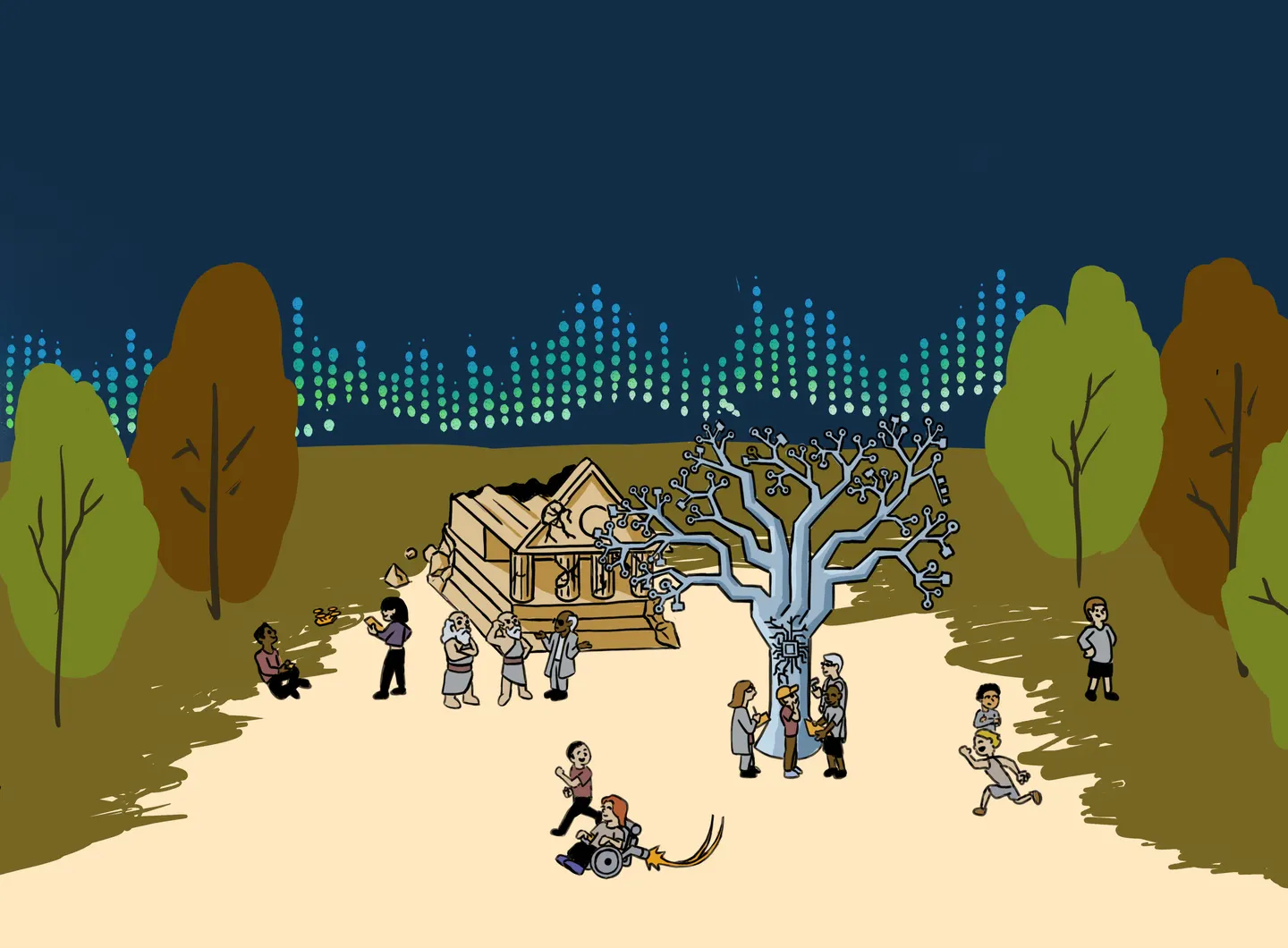
Why can't a machine do it instead? The Triad™ of Critical, Scientific, and Quantitative Thinking applied to your problem tiene lugar el jue, 12 nov 2026 a las 10:00 (GMT+1) en Barcelona, CT, y continúa hasta las 14:00. Las entradas cuestan €100 + en Luma.
Sobre este evento
Un taller titulado "¿Por qué no puede hacerlo una máquina en su lugar?" se centra en la tríada del pensamiento crítico, científico y cuantitativo, aplicando estos principios a problemas del mundo real. Tiene una duración de cuatro horas y está diseñado para profesionales que buscan comprender el papel de la inteligencia artificial y la inteligencia humana en su trabajo.
Čeština · Deutsch · Deutsch · Español · Français · Français · Français · Italiano · 日本語 · 한국어 · Nederlands · Português · Português · 中文
Descripción completa del organizadorMostrar menos
Machines have been automating human work for decades, but LLMs changed how we perceive and value Human Intelligence. For the first time in history we, humans, need not only to be good at our jobs, but answer the question and justify: "Why can't a machine do it instead?" If four years into the AI era you're still uneasy about trusting it, unsure whether LLMs will make your job unrecognizable and unclear about the knowledge/skills worth investing you time in, you're certainly not alone! You're in good company to build scientific & technological expertise, and go beyond theory: we run it through a problem you or your organization are facing to build a practical framework you can follow through with. While anthropical and even superhuman features are often attributed to AI/ML (Artificial Intelligence & Machine Learning) models, they are mere statistical tools (albeit complicated ones); therefore, understanding their bases is necessary to grasp their capabilities and limitations. More importantly, real intelligence is not computable; therefore model application cannot replace human intelligence to solve open-ended problems. The goal of this workshop is to present the Triad of Critical, Scientific, and Quantitative Thinking – a core set of principles and skills that are the basis for solid scientific, technological & data literacy – and apply it to real-world problems. The training will give professionals an organizations alike a formal framework upon which to build their world models and problem-solving processes during and beyond the workshop. Outcomes Individuals taking this course will leave with a critical and scientific perspective of how AI/ML can augment their capabilities where it is suitable, but also identify where and how their judgement is essential, and how to justify it to their peers or supervisors. The conceptual foundation that drives these outcomes is a general conceptual understanding of statistical models. Beyond the theory, leaders and teams will leave with a blueprint for making the choices about where automate within their organization, and where to focus irreplaceable human intelligence. Participants who opt-in will receive with follow up support to a specific problem they are tackling. Aligned audience While The Triad is likely to be a transformative paradigm for most humans, this course is especially beneficial to the following profiles: Leaders seeking tangible support about automating tasks and reorganizing team priorities; Creative professionals who know the value of their work, but feel lost or confused on how to speak the language of automation; Engineers and other technical staff who are under pressure to automate their workflows and/or need to justify the irreplaceability of their skills. Prerequisites The only real requirement for this workshop is curiosity about why the tools work the way they do – not just how to be a user; Bring a personal or professional project or question you’d like to tackle from critical & scientific perspective; Bring yourself, curiosity and desire to go beyond your comfort zone to understand essential technical tools conceptually; Specific mathematical & technical knowledge is NOT required: start where you are, and we'll meet you there. Duration 4-hour workshop Program Introduction: What are Critical, Scientific & Quantitative Thinking? (20 minutes) Hands-on I. Brief discussion: Can we now buy Intelligence on a meter[ed API]? 2. Critical Thinking: Reflective Development of Human Judgement (30 minutes) Hands-on II. No-judgement practice of your judgement skills: formalize the logic of a statement or business problem you believe is true/false 3. The Scientific Method: formulating models and testing hypotheses (30 minutes) Hands-on III. Convert your real-world problem into a scientific model 4. Quantitative Literacy: Mathematical, Computational, and Statistical Expertise Explained (20 minutes) Hands-on IV. Self-assessment and discussion: find yourself on a scale of 'Expert > Literate > Naïf' and discuss your needs for individual and team/collaborative training/growth 5. Probabilistic & Statistical Intuition (Part 1): Ground truth, data, and generative models (20 minutes) Hands-on V. Identify your Generative System, build a Generative Model, and interrogate whether they are reproducible by Generative AI 6. Probabilistic & Statistical Intuition (Part 2): Statistical Models, Machine Learning & Artificial Intelligence (30 minutes) Hands-on VI. Using Statistical & Machine Learning models to quantify and reduce uncertainty 7. The Triad of Critical, Scientific & Quantitative Thinking: Integrating Subjective and Objective assessments in practice (20 minutes) Hands-on VII. Paint the Big Picture: Think and implement AI/ML under a Critical & Scientific framework 8. Automate everything possible, but not more: get hands-on with the Triad and build a framework that works for your specific problem (40 minutes) Hands-on VIII. Create a blueprint for a technical, business, scientific problem that uses Statistical AI/ML models to be used in the wild Discounted tickets and subsidized seats are available. For more information contact the organizers. Perks and follow up All individual participants will get dedicated advisory for the hands-on work during the workshop. **Extended** ticket holders are granted 2 hours of private one-on-one advisory sessions for their specific project (€ 300+ value).
Sigue viendo
Todos los eventos de Barcelona →Eventos similares
Ver todo →








Detalles
- Cuándo
- jue, 12 nov 2026 · 10:00 (GMT+1) · hasta las 14:00
- Dónde
- Barcelona, CT
- Precio
- €100 +
- Género
- ai
- Tiempo
- 20°C · Llovizna ligera · 51% precip.Previsión a las 10:00 (GMT+1)
Preguntas
- ¿Cuándo es Why can't a machine do it instead? The Triad™ of Critical, Scientific, and Quantitative Thinking applied to your problem?
- jue, 12 nov 2026 a las 10:00 GMT+1.
- ¿Cuánto cuestan las entradas para Why can't a machine do it instead? The Triad™ of Critical, Scientific, and Quantitative Thinking applied to your problem?
- Las entradas cuestan €100 +.
- ¿Dónde es Why can't a machine do it instead? The Triad™ of Critical, Scientific, and Quantitative Thinking applied to your problem?
- Barcelona, CT.
- ¿Dónde puedo comprar entradas para Why can't a machine do it instead? The Triad™ of Critical, Scientific, and Quantitative Thinking applied to your problem?
- Las entradas se venden en Luma. Esta página enlaza directamente a ese evento; aquí no se venden entradas.
- ¿A qué hora termina Why can't a machine do it instead? The Triad™ of Critical, Scientific, and Quantitative Thinking applied to your problem?
- Continúa hasta las 14:00.