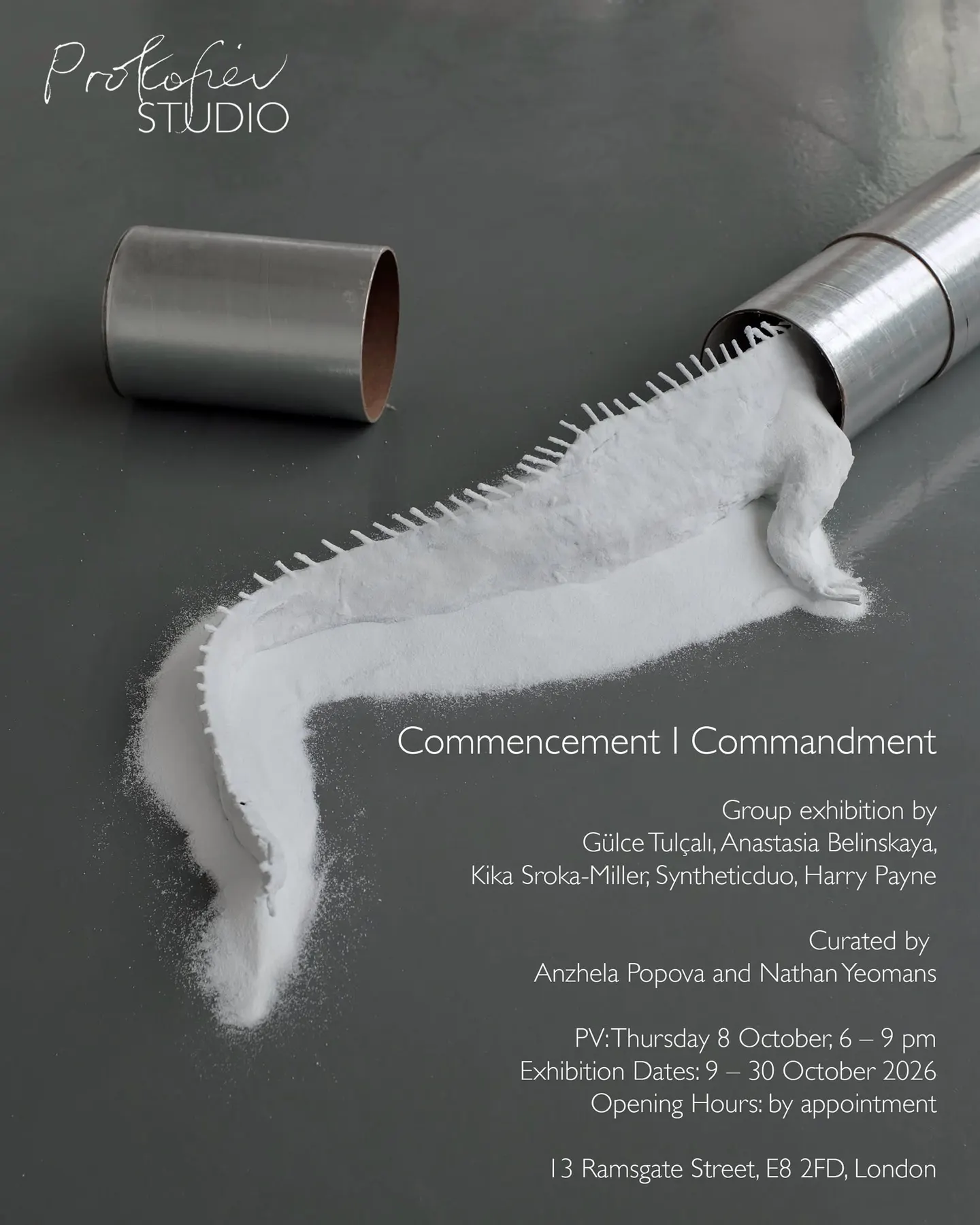
Commencement I Commandment
Commencement I Commandment takes place on Thu, 8 Oct 2026 at 18:00 (GMT+1) at Prokofiev Studio in London, United Kingdom, and runs until 21:00. Entry is free; the listing is on Luma.
About this event
Commencement/Commandment explores the nature of archives through works by Anastasia Belinskaya, Gülce Tulçalı, Kika Sroka-Miller, Synthetic Studio, and Harry Payne. The exhibition presents geological materials, surveillance imagery, digital infrastructure concepts, and paintings that examine how history is preserved and transformed.
Full description from organizerShow less
Curated by Anzhela Popova and Nathan Yeomans Private Viewing: Thursday 8 October, 6 – 9 pmExhibition Dates: 9 – 30 October 2026Opening Hours: by appointment Location: 13 Ramsgate Street, E8 2FD, London The archive: if we want to know what that will have meant, we will only know it times to come. Perhaps. Not tomorrow but in times to come, later on or perhaps never. Jacques Derrida ‘Archive Fever’ Commencement/Commandment takes Jacques Derrida’s Archive Fever as a point of departure to consider the archive not as fixed or linear, but as something continually disturbed and re-negotiated. Bringing together works by Anastasia Belinskaya, Gülce Tulçalı, Kika Sroka-Miller, Synthetic Studio and Harry Payne, the exhibition considers the archive through different registers: material, technological, speculative and personal. Across the exhibition, these different forms do not aim to present a complete or chronological history. Instead, they point towards an archive made up of fragments: things preserved and things lost, things that can be accessed and others that remain out of reach. For Derrida, the impulse to preserve is never entirely separate from the possibility of loss. An archive is thereby shaped not only by what enters it, but by what remains outside, who is able to access it, and how its contents come to be read later on. In this sense, an archive does not simply tell us what happened. Rather, it participates in producing the conditions through which something may become history at all. This feels particularly relevant now, when the act of recording has become almost constant: photographs, surveillance, scrolling, data and digital traces are produced at a speed that increasingly complicates what might constitute evidence, memory or even truth. The works in Commencement/Commandment approach this problem from notably different positions. Anastasia Belinskaya works with coal, quartz, aluminium and ice, treating matter itself as something capable of holding histories that extend far beyond a human lifespan. Geological material itself becomes a kind of record, carrying within it histories of extraction, climate and transformation. Gülce Tulçalı brings the question of the archive much closer to the technologies through which contemporary life is observed and circulated. Through surveillance imagery and digitally connected systems, her work asks what happens when our bodies and actions are being recorded almost as they occur: when the archive begins to form before we have chosen what, if anything, should be remembered. In “Clouds That Never Rain” (2026), Syntheticduo (Anastasia Belinskaya & Polina Kravchenko) turn towards another infrastructure of contemporary memory: the physical systems concealed behind the metaphor of “the cloud.” What is commonly imagined as weightless, instantaneous and placeless is grounded in an expanding network of data centres – vast architectures dependent on land, energy, water and systems of extraction. The work exposes the material conditions underlying digital storage, bringing the apparently immaterial archive back into contact with architecture, ecology and resource consumption. The cloud, rather than an abstract elsewhere in which information simply persists, emerges as a physical territory with its own limits, dependencies and consequences. Kika Sroka-Miller’s paintings approach the archive less through preservation than through our desire to make things legible. Fragments of symbol, shape and reference sit within compositions that resist being resolved into a single reading. Perhaps, this is also an archival impulse: the need to categorise, name and arrange fragments so that they begin to mean something. Harry Payne addresses this structure most overtly, and most personally. In Find the Archive, access itself becomes the problem. Moving through a fictional world in search of an undisclosed archive, the viewer is confronted with questions of ownership and exclusion: who is able to find their history, who has been kept outside of it, and whether an archive can ever truly belong to everyone. Holding these works within Prokofiev Studio introduces another, somewhat quieter layer to these questions. The studio itself exists through an act of preservation and reactivation: works and materials connected to Oleg Prokofiev have survived, moved between contexts and generations, and are now encountered again from the position of the present. And yet, survival does not mean returning something to an untouched past. Each encounter produces another reading, and each act of displaying, cataloguing or placing an older work beside a contemporary one inevitably changes the way it can be understood. The archive that emerges across the exhibition is therefore neither neutral nor complete. It is geological and digital, institutional and personal, material and interpretative. It can preserve, but it can also exclude; it can make something visible while obscuring something else. Its gaps are not simply failures of preservation but part of the structures through which histories are produced. Perhaps, then, the archive is less a place in which history sits still than a process through which it keeps changing. Commencement/Commandment does not attempt to define what an archive should contain, but considers the different ways something comes to be preserved, interpreted, withheld or transformed – and what might happen to it next. ABOUT ARTISTS Gülce Tulçalı is a London-based artist working across film and photography, with a practice centred on women, political structures and the possibilities of imagining alternative worlds. Drawing on dystopian fiction, surreal cinema and black-and-white photography, she creates symbolic visual narratives in which women perform fictional rituals and inhabit spaces between reality and speculation. Often working collaboratively with friends, family and other artists, Tulçalı uses familiar landscapes and everyday objects to construct a distinctive visual
Keep going
All London events →Similar events
View all →


Details
- When
- Thu, 8 Oct 2026 · 18:00 (GMT+1) · until 21:00
- Where
- Prokofiev Studio
- Address
- Prokofiev Studio, 13 Ramsgate St, London E8 2FD, UK
- Price
- Free
- Genre
- arts
- Weather
- 14°C · ClearForecast at 18:00 (GMT+1)
Questions
- When is Commencement I Commandment?
- Thu, 8 Oct 2026 at 18:00 GMT+1.
- How much are tickets for Commencement I Commandment?
- Entry is free.
- Where is Commencement I Commandment?
- Prokofiev Studio, Prokofiev Studio, 13 Ramsgate St, London E8 2FD, UK, London, United Kingdom.
- Where can I buy tickets for Commencement I Commandment?
- Tickets are sold on Luma. This page links straight to that listing; no tickets are sold here.
- What time does Commencement I Commandment end?
- It runs until 21:00.