This event has passed
It took place today. See upcoming business & networking in Burlington
Knowledge Managemen1-Day Workshop | Vermont
Knowledge Managemen1-Day Workshop | Vermont took place on Wed, Sep 16, 2026 at 9:00 AM (EDT) at For venue details reach us at [email protected] in Burlington, VT.
About this event
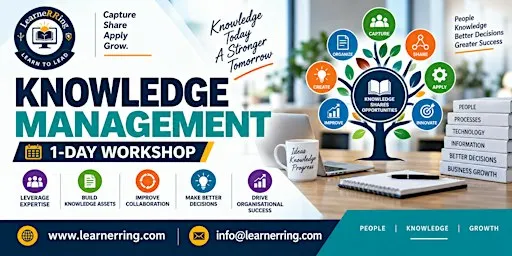
This session explores capturing organizational knowledge to improve sharing and build a smarter workplace. Participants learn strategies for fostering collaboration and retaining valuable information within their teams.
Full description from organizerShow less
Capture Organizational Knowledge, Improve Knowledge Sharing & Build a Smarter Workplace Event Details • Duration: 1-Day Practical Training (8 Hours) • Timing: 9:00 AM – 5:00 PM (including breaks) • Location: Location shared via email ( Complete Address ) • City Selection: Select your preferred city. We’ll confirm the nearest available training location after registration. Onsite training is also available on request. • Format: Classroom Training (Virtual option available on request) • Language: English • Certificate: Course Completion Certificate • PDUs Awarded: 8 Professional Development Units • Contact: [email protected] Event Description Knowledge is one of an organization's most valuable assets. It exists in documents, systems, processes, customer interactions, project experience, lessons learned, and—most importantly—in the expertise and experience of employees. When this knowledge is not captured or shared effectively, organizations can lose valuable expertise, repeat mistakes, duplicate work, make slower decisions, and become overly dependent on individual employees. This practical Knowledge Management 1-Day Workshop provides participants with a structured approach to identifying, capturing, organizing, sharing, applying, and protecting organizational knowledge. Participants will explore the difference between data, information, and knowledge; understand tacit and explicit knowledge; examine the knowledge lifecycle; and learn practical methods for capturing valuable employee and organizational knowledge. The workshop also explores knowledge repositories, communities of practice, lessons learned, knowledge transfer, organizational learning, knowledge governance, technology, and the emerging role of AI-enabled tools in supporting knowledge discovery and access. Rather than treating Knowledge Management as simply a technology initiative, the workshop emphasizes the combination of people, processes, culture, governance, and technology required to make knowledge accessible and useful. Through practical exercises, knowledge-mapping activities, workplace scenarios, and action planning, participants will develop practical ideas for strengthening knowledge management within their own teams and organizations. What You Will Learn • Understand the principles of Knowledge Management. • Distinguish between data, information, and knowledge. • Understand tacit and explicit knowledge. • Identify critical organizational knowledge. • Recognize where important knowledge resides. • Understand the Knowledge Management lifecycle. • Capture knowledge before it is lost. • Convert individual knowledge into organizational knowledge. • Apply practical knowledge-capture techniques. • Develop knowledge maps. • Improve knowledge documentation. • Organize knowledge for easier access. • Improve knowledge sharing across teams. • Reduce knowledge silos. • Develop communities of practice. • Capture lessons learned from projects and activities. • Improve knowledge transfer during employee transitions. • Understand major Knowledge Management models. • Identify cultural barriers to knowledge sharing. • Establish appropriate Knowledge Management governance. • Understand the role of technology and AI in Knowledge Management. • Measure Knowledge Management effectiveness. • Develop a practical Knowledge Management implementation plan. Workshop Modules Module 1: Understanding Knowledge Management • What Knowledge Management means. • Why organizational knowledge matters. • Understanding knowledge as a business asset. • Knowledge Management and organizational performance. • The relationship between people, processes, and technology. • Common Knowledge Management challenges. • The cost of inaccessible or lost knowledge. • Knowledge Management versus information management. • Understanding organizational memory. • Identifying opportunities for better Knowledge Management. Module 2: Data, Information, Knowledge and Expertise • Understanding data. • Understanding information. • Understanding knowledge. • Moving from information to actionable knowledge. • Explicit knowledge. • Tacit knowledge. • Individual versus organizational knowledge. • Understanding expertise and experience. • Recognizing knowledge embedded in processes. • Identifying high-value organizational knowledge. • Understanding why some knowledge is difficult to capture. Module 3: The Knowledge Management Lifecycle • Understanding the Knowledge Management lifecycle. • Knowledge creation. • Knowledge acquisition. • Knowledge capture. • Knowledge organization. • Knowledge storage. • Knowledge sharing. • Knowledge application. • Knowledge updating. • Knowledge retention. • Knowledge retirement and archiving. • Creating continuous knowledge flows. Module 4: Identifying and Mapping Critical Knowledge • Identifying knowledge required for business success. • Understanding knowledge dependencies. • Identifying subject-matter experts. • Locating knowledge across teams and systems. • Recognizing critical knowledge gaps. • Identifying knowledge silos. • Assessing knowledge-loss risk. • Understanding knowledge bottlenecks. • Creating a knowledge inventory. • Developing a knowledge map. • Prioritizing knowledge for capture and transfer. Module 5: Capturing Tacit and Explicit Knowledge • Understanding the challenges of capturing experience. • Knowledge-capture interviews. • Expert debriefs. • Process documentation. • Standard operating procedures. • Checklists and guides. • Storytelling as a knowledge-capture technique. • Job shadowing. • Mentoring and peer learning. • After-action reviews. • Capturing lessons learned. • Converting experience into reusable organizational knowledge. Module 6: Knowledge Management Models and Frameworks • Understanding the purpose of KM models. • Introduction to the Nonaka and Takeuchi SECI model. • Socialization. • Externalization. • Combination. • Internalization. • Understanding the Wiig Knowledge Management model. • Exploring knowledge creation and organizational learning. • Selecting frameworks appropriate to organizational needs. • Moving from theoretical models to practical application. • Avoiding unnecessary complexity in Knowledge Management. Module 7: Organizing and Managing Knowledge Repositories • Understanding knowledge repositories. • Creating logical knowledge structures. • Categorizing organizational knowledge. • Developing naming conventions. • Using metadata and tagging. • Improving searchability. • Managing document versions. • Identifying ownership. • Maintaining content quality. • Reviewing outdated information. • Establishing retention and archival practices. • Making knowledge easier to find and reuse. Module 8: Building a Knowledge-Sharing Culture • Understanding why employees share or withhold knowledge. • Identifying cultural barriers. • Reducing knowledge hoarding. • Building trust. • Encouraging collaboration. • Creating psychological safety for learning and questions. • Recognizing knowledge-sharing behaviors. • Building peer-to-peer learning. • Developing communities of practice. • Using mentoring and coaching. • Creating regular knowledge-sharing routines. • Making knowledge sharing part of everyday work. Module 9: Knowledge Transfer and Retention • Understanding knowledge-loss risk. • Identifying critical roles and expertise. • Preparing for employee transitions. • Knowledge transfer during onboarding. • Knowledge transfer before employees leave. • Creating structured handovers. • Using mentoring and shadowing. • Capturing role-specific knowledge. • Developing succession-related knowledge plans. • Preventing dependency on a single expert. • Maintaining continuity during organizational change. • Building stronger organizational memory.
Keep going
All Burlington events →Similar events
View all →

Details
- When
- Wed, Sep 16, 2026 · 9:00 AM (EDT)
- Where
- For venue details reach us at [email protected]
- Address
- PH: +1505 369 2908, Vermont, VT 05401
- Price
- $519.25 +
- Genre
- Workshops & Training
Questions
- When was Knowledge Managemen1-Day Workshop | Vermont?
- Wed, Sep 16, 2026 at 9:00 AM EDT.
- Where was Knowledge Managemen1-Day Workshop | Vermont?
- For venue details reach us at [email protected], PH: +1505 369 2908, Vermont, VT 05401, Burlington, VT.