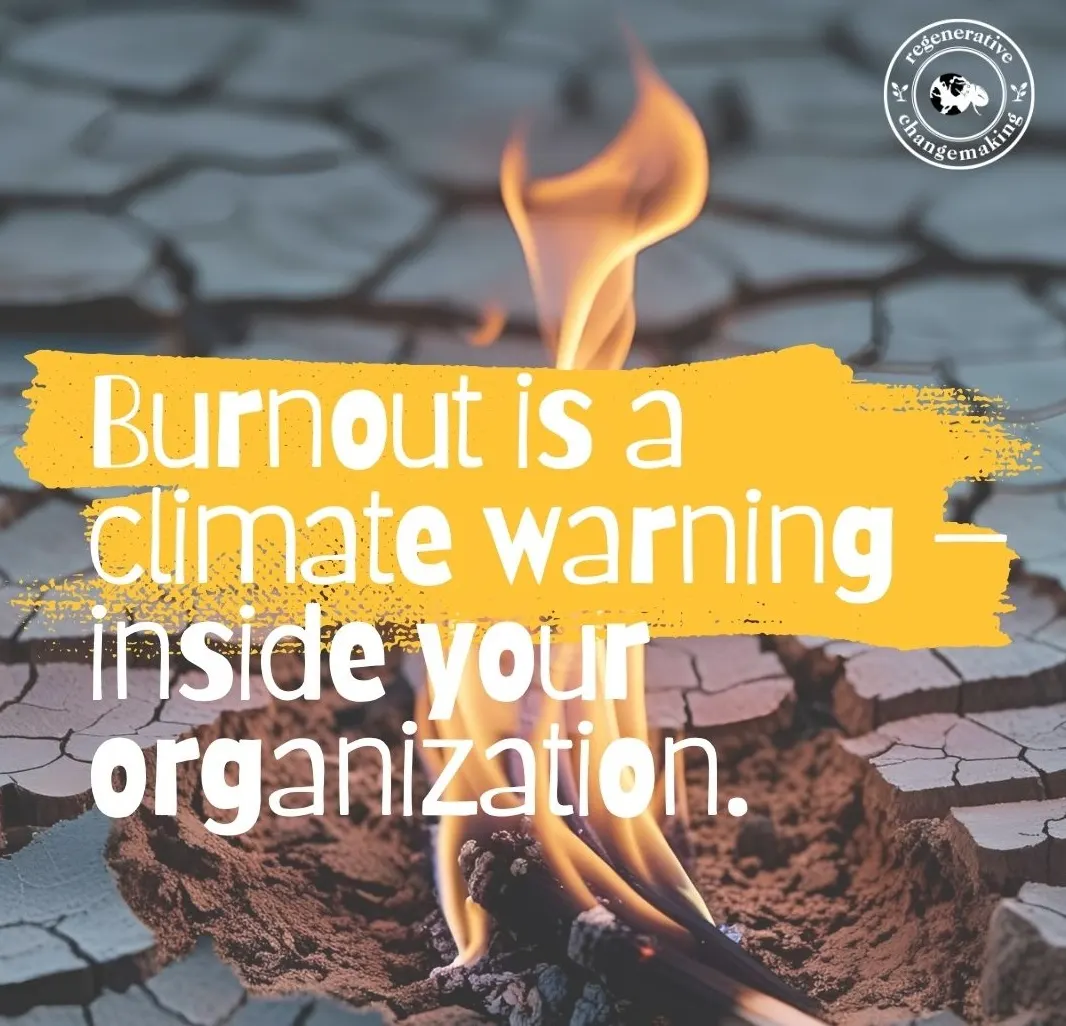
Burnout is Climate Change in Your Body: Can we create a regenerative future with extractive ways of working?
Burnout is Climate Change in Your Body: Can we create a regenerative future with extractive ways of working? takes place on Wed, Sep 23, 2026 at 4:30 PM (EDT) at 134 W 29th St in New York, NY, and runs until 6:00 PM. Entry is free; the listing is on Luma.
About this event
Marion Brastel facilitates a participatory session exploring burnout as a signal of systemic issues within climate and social change organizations. Participants engage in embodied practices to examine how regenerative leadership can transform organizational cultures rather than relying on individual endurance.
Full description from organizerShow less
About the session We talk constantly about resilience. Resilient communities. Resilient organizations. Resilient ecosystems. Resilient movements. But what about the people trying to create them? Across climate and social change, people are working against enormous urgency. The problems are accelerating, the resources rarely feel sufficient, and there is always another campaign, funding deadline, crisis, negotiation, or organizational challenge demanding attention. The expectation is often that the people doing this work will simply keep going. Until they can't. Burnout is usually framed as an individual wellbeing problem. Rest more. Set better boundaries. Become more resilient. Learn to manage stress. But what if burnout is also information? What if exhaustion, disconnection, leadership fatigue, and strained relationships are signals about the systems and cultures in which changemakers are being asked to operate? Regenerative Changemaking (RCM) works with people and organizations tackling climate and ecological challenges and sees these pressures showing up not only in workloads, but in people's bodies, nervous systems, relationships, leadership, and organizational cultures. This session starts from the proposition that we cannot build regenerative systems through ways of working that continually deplete the people trying to create them. So what would change if climate organizations and movements were designed around regeneration rather than endurance?What if regeneration isn't just something we want for the world outside us, but something we need to build into the way we work? What would we notice if we treated burnout as a systems signal rather than evidence that an individual has failed to cope? Which organizational norms would we have to reconsider? What would regenerative leadership actually look and feel like? And what responsibility do funders, boards, and institutions have for creating the conditions in which people can sustain difficult work over time? The goal is not to remove urgency from climate work. The urgency is real. It is to ask whether exhausting the people responding to that urgency is actually helping us meet it and start asking what conditions allow people, organisations and movements to regenerate. What to expect A participatory session combining reflection, embodied practice and collective inquiry. Rather than spending the session talking about burnout from a distance, participants will have opportunities to notice how pressure, depletion and the rhythms of their work show up in their own ways of working and to explore what different practices might make possible. RCM co-founder Marion Brastel will facilitate a conversation about the assumptions underneath climate and social-impact work: what we reward, what we normalize, what we ask people to endure, and what might change if regeneration became part of how organizations and movements actually operate. This is not a session about self-care as another item on an already impossible to-do list. It is an exploration of what becomes possible when we stop asking people to adapt indefinitely to systems and cultures that are exhausting them. Who this is for This session is for people working across climate, philanthropy, conservation, social change, and systems transformation, particularly those carrying responsibility for organizations, movements, teams, funding decisions, or other people. What you will get out of it A different way of understanding burnout as a signal about organizational and sector conditions, not only individual wellbeing Space to compare experiences with others carrying responsibility across climate and social change A chance to examine the assumptions about urgency, productivity, resilience, and endurance embedded in how change work is organized New questions and practical possibilities for what regenerative ways of working could look like within teams, organizations, movements, and funding relationships Featuring Marion Brastel, Co-Founder, RCM Hosted by Regenerative Changemaking
Keep going
All New York events →Similar events
View all →




Details
- When
- Wed, Sep 23, 2026 · 4:30 PM (EDT) · until 6:00 PM
- Where
- 134 W 29th St
- Address
- 134 W 29th St, New York, NY 10001, USA
- Price
- Free
- Genre
- Cultural Events
Questions
- When is Burnout is Climate Change in Your Body: Can we create a regenerative future with extractive ways of working??
- Wed, Sep 23, 2026 at 4:30 PM EDT.
- How much are tickets for Burnout is Climate Change in Your Body: Can we create a regenerative future with extractive ways of working??
- Entry is free.
- Where is Burnout is Climate Change in Your Body: Can we create a regenerative future with extractive ways of working??
- 134 W 29th St, 134 W 29th St, New York, NY 10001, USA, New York, NY.
- Where can I buy tickets for Burnout is Climate Change in Your Body: Can we create a regenerative future with extractive ways of working??
- Tickets are sold on Luma. This page links straight to that listing; no tickets are sold here.
- What time does Burnout is Climate Change in Your Body: Can we create a regenerative future with extractive ways of working? end?
- It runs until 6:00 PM.