Tickets are sold out
The source listing reports no tickets left for this event. Check Eventbrite for the latest
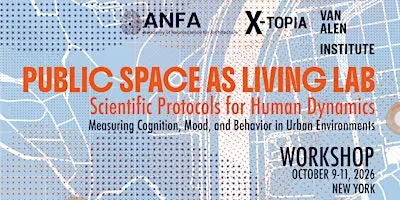
Public Space as a Living Lab: Scientific Protocols for Human Dynamics
Public Space as a Living Lab: Scientific Protocols for Human Dynamics takes place on Fri, Oct 9, 2026 at 8:30 AM (EDT) at Van Alen Institute in New York, NY. Tickets are $482.02 + on Eventbrite.
About this event
This three-day workshop uses New York City's public spaces as a living lab. Participants engage in hands-on activities that bridge design, science, and community.
Full description from organizerShow less
A 3-day, hands-on workshop using New York City’s public spaces as a living lab to bridge design, science, and community. NEXT EDITION: NEW YORK, APRIL 2027 The October 2026 edition is sold out. PUBLIC SPACE as a LIVING LAB returns to New York in April 2027, and registration will open to our interest list before it opens to the public. Add your name here to be notified first: form. Joining the list is free and commits you to nothing. Public Space as a Living Lab is a three-day immersive workshop introducing architects, urban designers, planners, researchers and public-sector professionals to scientific protocols for measuring human experience in public space. Rather than relying exclusively on observations or questionnaires, participants learn how to combine physiological, cognitive, affective and behavioral methods into one coherent field protocol. Participants experience the workshop from three perspectives: researcher, subject and observer. Through repeated role changes they learn not only how evidence is collected, but also how methodological decisions influence interpretation. This workshop bridges environmental psychology, neuroscience, architecture and urban design by teaching participants how to formulate hypotheses, collect evidence in real urban settings and translate results into future design decisions. More than a workshop, it is an immersive learning experience where participants will gain practical tools to design healthier, more livable, and human-centered public spaces while exploring innovative approaches at the intersection of design, science, and technology. The workshop combines lectures, fieldwork, rapid prototyping, data collection, and collaborative synthesis. It will take place across outdoor public spaces — where interventions and measurements will be tested — and indoor spaces hosted by the Van Alen Institute, where lectures, tools training, synthesis sessions, presentations, and group debriefs will take place. Participants will work across three parallel tracks: • Cognition & Navigation: How do people orient themselves, remember landmarks, make decisions, and move through urban environments? • Mood, Stress & Restoration: How do public spaces affect emotional state, perceived restoration, stress, comfort, and attention? • Behavior & Social Interaction: How do spatial conditions influence dwelling, encounter, movement, seating, and collective use of public space? Who is this for? This workshop is open to students, professionals, researchers, and civic practitioners interested in the relationship between people and the built environment. It is especially relevant for architects, urban designers, landscape architects, planners, public-sector professionals, researchers, students, recent graduates, community organizations, and anyone interested in evidence-based approaches to public space, health, behavior, and urban life. No prior experience with neuroscience or data collection is required. Learning Outcomes By the end of the workshop participants will be able to formulate hypotheses, choose appropriate measurement tools, design standardized field protocols, collect multimodal data, understand limitations, avoid overclaiming, and translate evidence into design recommendations. Participants will learn how to: • understand the theoretical foundations of public space, livability, placemaking, and human-centered/ evidence-based urban design • explore how interdisciplinary fields such as environmental psychology and neuroscience inform the design and evaluation of public spaces • study cognition, mood, and behavior in public-space settings • use basic field protocols to evaluate human experience • work with observational, self-report, behavioral, and physiological measures • prototype and test small-scale reversible interventions • translate findings into evidence-based design strategies • communicate insights to broader audiences • develop actionable recommendations to improve the livability, well-being, and user experience of public spaces Workshop Structure Day 1 - Understand Theme: Day 1 focuses on understanding before measuring. Participants are introduced to the scientific rationale, measurement tools and operational workflow before entering the field. 08:30–09:00 Registration, coffee and welcome 09:00–09:30 Opening lecture: Why measure human experience? Multimodal evidence in architecture. 09:30–10:15 Lecture 1- Affect: Prospect–Refuge, Stress Recovery, Biophilia, perceived safety. 10:15–10:30 Coffee break 10:30–11:15 Lecture 2 - Cognition: Attention Restoration, cognitive maps, processing fluency, coherence. 11:15–12:00 Lecture 3 - Behavior: Affordances, behavior settings, Gehl and Whyte. 12:00–12:30 Group discussion: From theory to hypotheses. 12:30–13:30 Lunch 13:30–14:15 Demonstration: Polar H10, Google Forms, PsyToolkit, QR workflow. 14:15–15:00 Demonstration: Behavioral mapping and observation protocol. 15:00–15:15 Break 15:15–16:00 Hands-on practice in groups of three with equipment. 16:00–16:45 Formation of Teams A, B and C. Participant IDs, researcher roles and rotation logic. 16:45–17:30 Walkthrough of Day 2 protocol, questions and final preparation. Day 2 - Measure Theme: Day 2 is the core experimental component of the workshop. Three comparable public-space settings are used as living laboratories where lightweight, reversible interventions are evaluated. Every intervention is assessed using the same multimodal protocol, combining physiological, cognitive, affective and behavioral measures. The goal is not to determine a single 'best' intervention but to understand how different environmental strategies influence multiple dimensions of human experience simultaneously. 08:30–09:00 Arrival, equipment calibration, participant IDs, station setup 09:00–09:20 Walk to the three settings and protocol briefing 09:20–10:20 Rotation 1 – Baseline measurements 10:20–11:20 Rotation 2 – Baseline measurements 11:20–12:00 Behavior mapping (15 min preparation + 25 min observation) 12:00–13:00 Lunch 13:00–13:45 Installation of interventions in public space 13:45–14:45 Rotation 1 – Post-intervention 14:45–15:45 Rotation 2 – Post-intervention 15:45–16:25 Behavioral mapping after intervention 16:25–17:00 Equipment collection, data verification and debrief Day 3 - Interpret Theme: Day 3 is intentionally different from a conventional data-analysis workshop. The goal is not to teach participants how to run statistics, but how to think like researchers and evidence-informed designers. Participants learn how to critically interpret evidence, recognize uncertainty, build hypotheses, and translate findings into practical design strategies. 08:30–09:00 Arrival + recap of Day 2 09:00–09:30 Opening talk: How to Think Like a Researcher 09:30–10:30 Data overview + first interpretation 10:30–10:45 Coffee break 10:45–12:00 Convergence & Divergence across Affect / Cognition / Behavior. 12:00–12:15 Short talk: Avoiding overclaiming + limitations 12:15–13:15 Lunch 13:15–13:45 Short talk: From limitations → future hypotheses 13:45–14:00 Translation into Design 14:00–14:15 Break 14:15–15:45 Team formation and presentation prep. (future hypothesis, design translation) 15:45–17:00 Final presentations + discussion 17:00–17:30 Closing reflection + networking The workshop is developed through a partnership between the Academy of Neuroscience for Architecture (ANFA), the Van Alen Institute, and X-Topia.
Keep going
All New York events →Similar events
View all →



Details
- When
- Fri, Oct 9, 2026 · 8:30 AM (EDT)
- Where
- Van Alen Institute
- Address
- 303 Bond Street, Brooklyn, NY 11231
- Price
- $482.02 +
- Genre
- 102/class, training, or workshop
Questions
- When is Public Space as a Living Lab: Scientific Protocols for Human Dynamics?
- Fri, Oct 9, 2026 at 8:30 AM EDT.
- How much are tickets for Public Space as a Living Lab: Scientific Protocols for Human Dynamics?
- Tickets are $482.02 +.
- Where is Public Space as a Living Lab: Scientific Protocols for Human Dynamics?
- Van Alen Institute, 303 Bond Street, Brooklyn, NY 11231, New York, NY.
- Where can I buy tickets for Public Space as a Living Lab: Scientific Protocols for Human Dynamics?
- Tickets are sold on Eventbrite. This page links straight to that listing; no tickets are sold here.