- When
- America/New_York (EST)
- Where
- Nightingale-Brown House357 Benefit Street, Providence, RI 02903
Tickets are sold on Eventbrite. We link straight to the listing — nothing is bought here. Listing details come from the source and can change. Eventovia indexes events; it does not organize them or sell tickets. Terms & Disclaimer
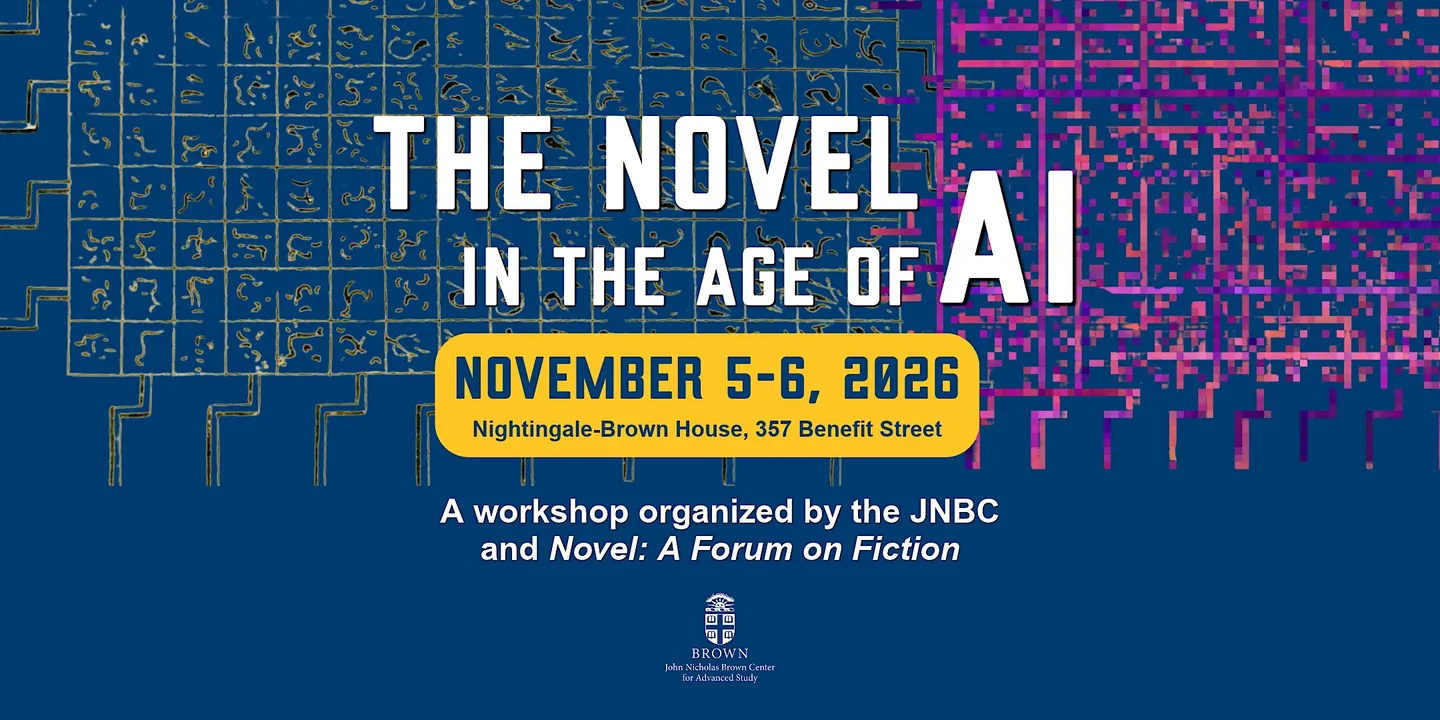
The Novel in the Age of AI (Day 2) takes place on Fri, Nov 6, 2026 at 9:30 AM (EST) at Nightingale-Brown House in Providence, RI. Entry is free; the listing is on Eventbrite.
About this event
A workshop explores how AI shapes novels, literary creativity, criticism, publishing, audiences, and literature's role in training AI.
Full description from organizerShow less
A workshop exploring how AI shapes novels, literary creativity, criticism, publishing, audiences, and the role of literature in training AI In a recent debate between two popular writers on AI and the future of literature, Sam Kahn argued that AI represents an “existential threat to the discipline.” His interlocutor, Henry Oliver wrote instead “I want to see literary people take AI seriously.” Rising to that challenge in this forum, we would like to consider the impact of generative AI on the literary arts more specifically to ask: How does AI influence the novel? To what extent does AI lead to new authorial practices, genres, or audiences? In parallel: How does computation shape the practice of critical analysis? What roles do algorithms play in the distribution of novels and other literary artifacts? And, conversely: what role did the novel play in the training of large language models? Our in-person workshop will be composed of eight presentations of work-in-progress over the course of two days. Co-organized by Kevin McLaughlin, Brown University (Director, John Nicholas Brown Center for Advanced Study, Brown University; Editor of Novel: A Forum on Fiction) and Dennis Yi Tenen, Columbia University (Associate Professor of English). Participants: Hannes Bajohr, UC Berkeley John Cayley, Brown Nan Da, Johns Hopkins James Draney, Haverford Kate Marshall, Notre Dame Kevin McLaughlin, Brown (Co-organizer) Zakir Paul, NYU Ellie Pavlick, Brown Dennis Yi Tenen, Columbia (Co-organizer) Register for Day 1 Friday, November 6 Session 2 (9:30 a.m.-12:00 p.m.) Dennis Yi Tenen: “The Standardization of Fast Fiction” The rapid expansion of popular fiction at the turn of the twentieth century depended on more than simply writing more. It also required new ways of organizing literary craft, characterized by the increased use of prefabricated textual components. This paper asks whether such changes left a measurable trace in the prose itself and what those changes may mean for the contemporary reconfiguration of authorial labor. Hannes Bajohr: “Latent Worlds: AI and the Novel” In my presentation, I will very briefly discuss my own attempts at writing a novel using AI and then lay out my current project that connects the idea of the "world model" in computer science - tied to classic, symbolic AI but making a comeback in current LLM discourse - to the idea that novels constitute worlds (especially with recourse to Hans Blumenberg). A description of this could look like this: “A world—nothing less—is the theme and postulate of the novel,” Hans Blumenberg wrote in 1963, as AI research was beginning to develop its own “world models.” Today, these literary and computational senses of world converge in LLMs, whose latent spaces can generate narratives with striking coherence but often weak causality. Drawing on literary traditions from realism to modernism and on my own experiments with a fine-tuned German-language model, the talk asks how novels and LLMs construct worlds through networks of relations, inferences, and expectations. It uses this comparison to situate AI-generated fiction between claims of machine understanding and dismissals of mere mimicry. John Cayley & Ellie Pavlick: “Datafied Close Reading to Steer Novelistic Generation: The Typhoon Project” The Typhoon project is an audiovisual literary installation with a large language model as its generative engine. It engages directly with 'the novel' by taking Joseph Conrad's Typhoon as its literal context. As a work in its own right, the project intends to be read as an original Conrad-related narrative, but its tenor is an aesthetic commentary on what Hannes Bajohr calls 'post-artificial' literary practice, offering an aboutness that reflects on literature's (re)active relations with generative models and the 'typhoon' of their novelistic and other outputs. Specifically, this presentation addresses John Cayley's datafied close reading of Conrad using certain innovative digital humanities methods in order to blur or to interface the horizons of traditional close reading and the more purely machine reading undertaken by models during their pretraining. Elle Pavlick's research for the project, we suggest, takes this datafied close reading and uses it to configure and to render more 'novelistic' the realtime generation of the Typhoon project's model, with techniques, including adaptive activation steering, that are innovative within the discipline of machine learning. Lunch Break (12:00-1:00 p.m.) Session 3 (1:00-3:00 p.m.) Kate Marshall: “Darling, how could we develop this beautifully?” In May of this year, the Nobel laureate Olga Tokarczuk ignited a controversy with remarks she made at a conference in Poznań, Poland. Several literary outlets reported Tokarczuk’s comments that she had used AI in the writing of her latest novel, There is Too Much World, published in Polish in October. Tokarczuk’s response to the outcry focused on her use of a language model as a research tool. In this paper, I will consider Tokarczuk’s claims about research as a question of novel theory, especially in discussions of fictionality, historical understanding, and documentation. I will then turn to the status of research, and specifically literary research, in contemporary institutions. In a moment when Vannevar Bush’s framing of frontier science is being resurrected in the service of a conception of research driven by AI collaboration, how does the novel renegotiate and reimagine the meaning of research? James Draney: “The Novel and the Problem of Singularity” The paper argues that the realist novel’s historical investment in singularity—understood here as the irreducible particularity of interior life rendered in language—has been made newly legible, and newly precarious, by the advent of Large Language Models. To flesh this out, this paper will examine Rachel Cusk’s Outline trilogy. Although written before the advent and dissemination of LLMs, the abiding impersonality of Cusk’s novels uncannily anticipates the linguistic conditions LLMs produce. The form of Cusk’s novels, in which a narrator channels others’ speech and dissolves the distinctions between those speakers, registers transformations in the cultural and psychological experience of singularity. Crucially, I’ll argue that Cusk’s novels do not mourn this transformation in singularity but regard it as a form of relief from the psychological burdens of liberal individualism. Coffee break (3:00-3:30 p.m.) Roundtable Discussion (3:30-4:30 p.m.)
Keep going
All Providence events →Similar events
View all →





Details
- When
- Fri, Nov 6, 2026 · 9:30 AM (EST)
- Where
- Nightingale-Brown House
- Address
- 357 Benefit Street, Providence, RI 02903
- Price
- Free
- Genre
- Panel & Seminar
- Weather
- 64°F · Rain · 38% precipForecast at 9:30 AM (EST)
Questions
- When is The Novel in the Age of AI (Day 2)?
- Fri, Nov 6, 2026 at 9:30 AM EST.
- How much are tickets for The Novel in the Age of AI (Day 2)?
- Entry is free.
- Where is The Novel in the Age of AI (Day 2)?
- Nightingale-Brown House, 357 Benefit Street, Providence, RI 02903, Providence, RI.
- Where can I buy tickets for The Novel in the Age of AI (Day 2)?
- Tickets are sold on Eventbrite. This page links straight to that listing; no tickets are sold here.