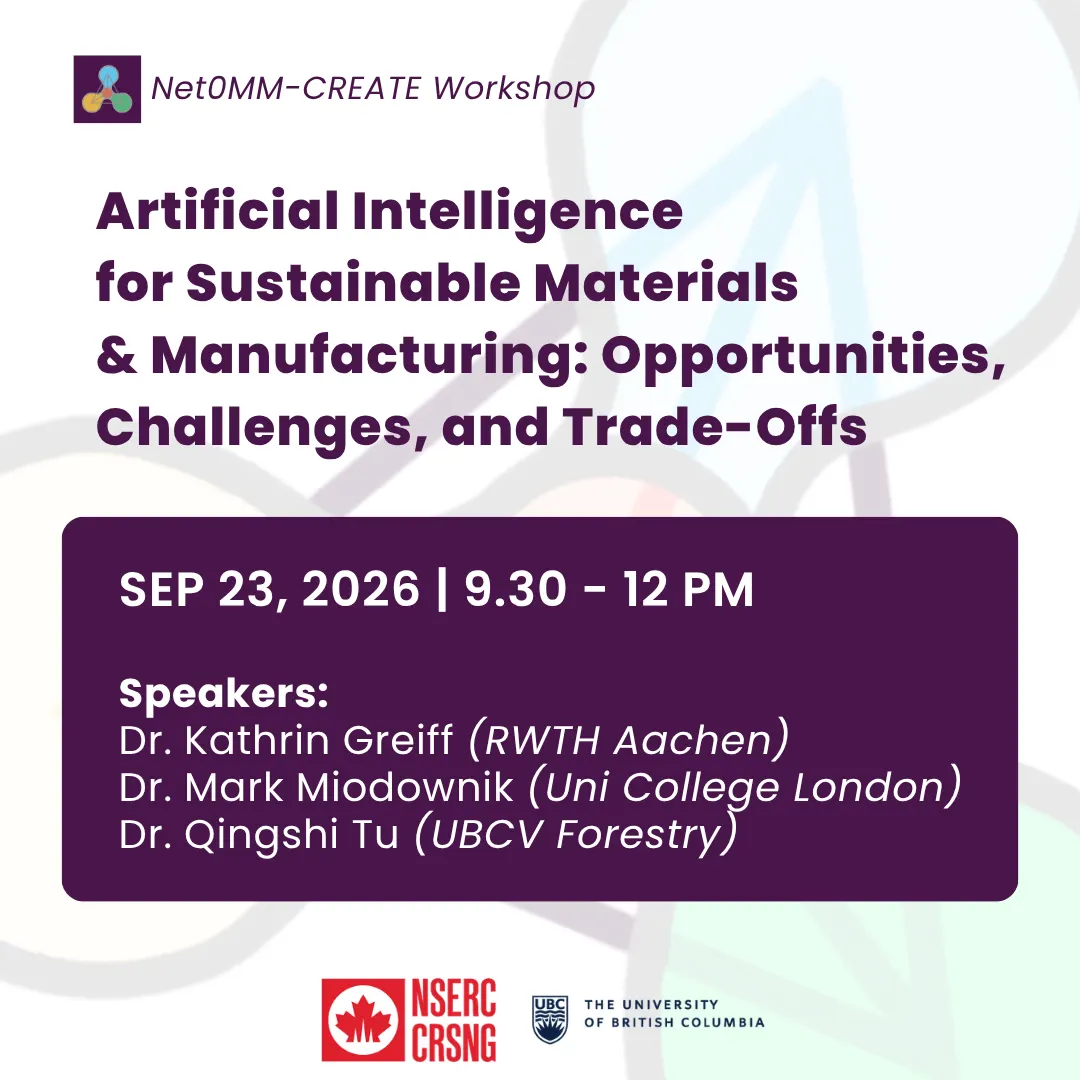
Artificial Intelligence for Sustainable Materials & Manufacturing: Opportunities, Challenges, and Trade-Offs
Artificial Intelligence for Sustainable Materials & Manufacturing: Opportunities, Challenges, and Trade-Offs takes place on Wed, Sep 23, 2026 at 9:30 a.m. (PDT) at The University of British Columbia in Vancouver, BC, and runs until 12:00 p.m.. Entry is free; the listing is on Luma.
About this event
Exact location will be updated closer to the event. This workshop welcomes three speakers who work at the intersection of AI and sustainability in materials and manufacturing - Dr. Mark Miodownik (UCL), Dr. Kathrin Greiff (RWTH Aachen), and Dr. Qingshi Tu (UBCV Forestry). Each speaker will speak for 25 mins, followed by a short break, then with a roundtable discussion.
Read full descriptionShow less
9:30 am - Arrival - Snacks / Coffee10:00 am - Welcome remarks (Dr. Chad Sinclair)10:05 am - Speaker 1 (Dr. Mark Miodownik)10:30 am - Speaker 2 (Dr. Kathrin Greiff)10:55 am - Speaker 3 (Dr. Qingshi Tu)11:20 am - Discussion12:00 pm - Workshop ends Workshop abstract: Artificial intelligence (AI) and machine learning (ML) are rapidly transforming research and practice across materials science and manufacturing, offering new opportunities to accelerate progress toward sustainability goals. This workshop will explore three emerging applications of AI/ML that support the transition to a more circular and sustainable economy; intelligent systems that improve access to repair options for manufactured products, machine vision for automated waste sorting and recycling, and machine learning approaches that enhance life cycle assessment and sustainability analysis. Following these presentations, participants will engage in a roundtable discussion examining a broader question: Does the use of AI and ML ultimately provide a net positive contribution to sustainable development? While AI has the potential to reduce waste, improve resource efficiency, and support better decision-making, it also carries significant environmental, economic, and societal costs, including increasing energy demands, critical mineral use, and ethical considerations. Framed within the context of the triple bottom line (environmental, economic, and social sustainability) the discussion will consider how researchers, industry, and policymakers can maximize the benefits of AI while minimizing its unintended consequences. Talk 2 – From Pixel to Circularity: AI-Enabled Sensor Data for Material Characterization and Environmental Assessment in Recycling (Dr. Kathrin Greiff) Abstract - Mechanical recycling remains constrained by a persistent lack of transparency: material flows are heterogeneous, throughput is high, and manual characterization can only ever sample a fraction of what passes through a plant. Sensor-based technologies — combined with machine learning — offer a way to close this gap, turning near-infrared, RGB, and mid-infrared signals into real-time information on material composition, purity, and quality. This talk shows how AI supports material characterization across plastics packaging (ReVise-UP), construction and demolition waste (KIMBA), and metals (SBQC) at RWTH Aachen's ANTS institute. Beyond quality control, these sensor data also feed mass-balance and environmental assessments, quantifying how sorting depth and packaging design affect yield, purity, and ecological-economic trade-offs. The talk closes by weighing these gains against the costs and limits of the technology itself. Talk 3 – Scaling LCA with AI: From Automation to Action (Dr. Qingshi Tu) Abstract - Artificial intelligence is rapidly changing what is possible in life cycle assessment (LCA). In only a few years, applications have progressed from assisting individual tasks such as semantic mapping and data extraction toward increasingly automated, end-to-end LCA workflows. These developments raise the prospect of dramatically reducing the time, cost, and expertise required to generate life-cycle information. But producing more LCAs should not be the objective in itself. The larger opportunity is to extend LCA to decisions that are currently underserved because conducting assessments at that scale is too time- and resource-intensive. Today, detailed sustainability assessment is often concentrated among large organizations with the resources to conduct it. AI-enabled LCA could expand access across products, firms, supply chains, and technologies, allowing environmental considerations to inform decisions at a scale previously impractical. This presentation will examine the rapidly evolving capabilities of AI for LCA, examples of where these approaches already work and where they remain unreliable, and the importance of validation, traceability, and human judgment. It will then consider a broader question: if AI allows us to scale LCA, how do we ensure that we are scaling sustainability action rather than simply scaling analysis?
Keep going
All Vancouver events →Similar events
View all →





Details
- When
- Wed, Sep 23, 2026 · 9:30 a.m. (PDT) · until 12:00 p.m.
- Where
- The University of British Columbia
- Address
- The University of British Columbia, 6200 University Blvd, Vancouver, BC V6T 1Z4, Canada
- Price
- Free
- Genre
- ai, climate
- Weather
- 53°F · Clear · 44% precipForecast at 9:30 a.m. (PDT)
Questions
- When is Artificial Intelligence for Sustainable Materials & Manufacturing: Opportunities, Challenges, and Trade-Offs?
- Wed, Sep 23, 2026 at 9:30 a.m. PDT.
- How much are tickets for Artificial Intelligence for Sustainable Materials & Manufacturing: Opportunities, Challenges, and Trade-Offs?
- Entry is free.
- Where is Artificial Intelligence for Sustainable Materials & Manufacturing: Opportunities, Challenges, and Trade-Offs?
- The University of British Columbia, The University of British Columbia, 6200 University Blvd, Vancouver, BC V6T 1Z4, Canada, Vancouver, BC.
- Where can I buy tickets for Artificial Intelligence for Sustainable Materials & Manufacturing: Opportunities, Challenges, and Trade-Offs?
- Tickets are sold on Luma. This page links straight to that listing; no tickets are sold here.
- What time does Artificial Intelligence for Sustainable Materials & Manufacturing: Opportunities, Challenges, and Trade-Offs end?
- It runs until 12:00 p.m..