The Allocators' Table: Climate capital across Europe, the US, Japan and Korea
- When
- Europe/Berlin (GMT+2)until 14:00
- Where
- Munich, GermanyMunich, Germany
Tickets are sold on Luma. We link straight to the listing — nothing is bought here. Listing details come from the source and can change. Eventovia indexes events; it does not organize them or sell tickets. Terms & Disclaimer
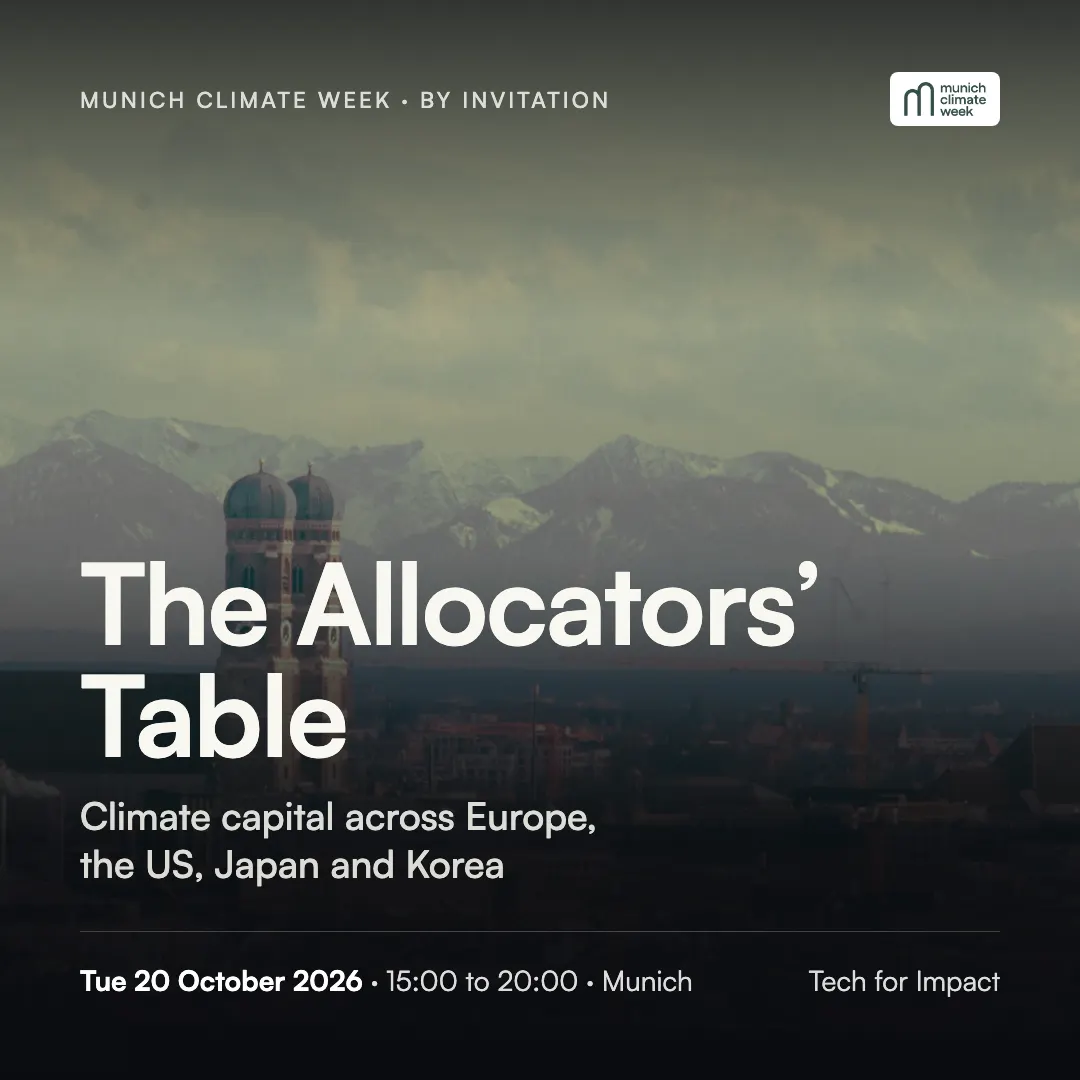
The Allocators' Table: Climate capital across Europe, the US, Japan and Korea takes place on Fri, 23 Oct 2026 at 11:00 (GMT+2) in Munich, Germany, and runs until 14:00. Entry is free; the listing is on Luma.
About this event
Tech for Impact Summit hosts an invitation-only lunch in Munich on Friday 23 October 2026 featuring roundtables under the Chatham House Rule, a fireside chat, and open networking to discuss climate capital across Europe, the US, Japan, and Korea.
Full description from organizerShow less
🌐 Language: English ♿ Wheel-chair accessible 💶 Event free of charge 🎟️ Hosted by: Tech for Impact Summit An invitation-only lunch for allocators: roundtables under the Chatham House Rule, a fireside chat over lunch, then open time to talk. Built to bridge Korea, Japan, the US and Europe. The follow-on to Tech for Climate at Oktoberfest. Friday 23 October 2026, 11:00 to 14:00, Munich. Held during Munich Climate Week (19 to 25 October 2026). Why this lunch At Tech for Climate at Oktoberfest in September, one table was kept for allocators only. Its question was simple: how do you go from caring about climate to putting money behind it? This lunch picks up where that table stopped, with the questions allocators are actually asking in October 2026. Defence, AI and power have taken the money climate funds raised in 2021. Who in this room has moved, who has stayed, and what do they now ask of a fund? Where does the money come back from? Should a foundation put its endowment, not just its grants, behind its mission? And what do Japanese and Korean corporates need before they commit to a European fund or buy from a European plant? We want this lunch to bridge Korea, Japan, the US and Europe. Seira Yun, the host, works between Europe, Asia and North America, so cross-border capital comes up at the tables and over lunch: corporate LPs from Japan and Korea, allocation across US, European and Asian funds, and who buys the output of a European plant. Endorsement “For almost 25 years I have brought researchers, founders and investors together in Munich. I know what makes such a gathering work, and Tech for Impact has it. It is by invitation only, its guest list curated by hand: founders, corporate leaders, family offices, investors and policymakers, from Japan, Europe and other regions, all senior decision makers. It cuts across industries, so energy, mobility, finance and manufacturing sit at the same table. It puts technology and impact on one agenda, with the people who can act on both in the room. Its Tokyo roots bring a Japanese corporate network into that room. It is built for collaboration: little time listening to a stage, much more working out what to do together, so people leave with a partner and a next step. The record shows it works: past gatherings have led to partnerships, corporate-startup collaborations and investment deals. In format and spirit it is truly creative and unique. I am glad to support Seira Yun in building it.” Prof. Dr. Helmut Schönenberger, Co-founder and CEO, UnternehmerTUM The format Roundtables first, then lunch with a fireside chat, then open networking. Roundtables: small groups, one question per table. A table lead opens with two minutes, then the table talks. The Chatham House Rule applies: use what you hear, never who said it. Fireside chat: a conversation while we eat. One question, no slides. We name the speakers once they confirm. Open networking: the last part of the lunch has no programme. This is where people find the peers they want to keep talking to. There are no sponsors, no pitches and nothing for sale. Attendance and lunch are free of charge. Run of show 11:00 Doors and coffee 11:30 Roundtables 12:30 Lunch and fireside chat 13:15 Open networking 14:00 Close The questions The tables and the fireside chat draw on the questions below. Which ones run, and who opens them, depends on who is in the room. When you register, please name the question you would most like to join. Where did the climate money go? Climate-specialist funds raised a fraction of what they did in 2021. Defence, AI and power raised the rest. Is "climate" still a line in the allocation, or a lens over infrastructure, energy and industrials? Who pays for the grid. Data centres, heat pumps and electric fleets all wait on the grid, and a connection can take years. Firm power, from storage to nuclear and fusion, had a record year. Where does an allocator in this room get exposure: an infrastructure fund, grid-technology venture, a corporate's own balance sheet? Who carries the merchant and permitting risk? Fusion, a venture bet or an infrastructure asset? Fusion raised a record $4.5bn in the twelve months to July 2026, according to the Fusion Industry Association. Munich is one of its centres: Proxima Fusion has signed with RWE, the Free State of Bavaria and the Max Planck Institute for Plasma Physics to build a commercial plant. What do investors underwrite when the first sale of power is years away? Who pays for the first plant when venture money runs out and infrastructure lenders will not take technology risk? Real DPI in climate venture. Liquidity in a ten-year asset class. Distributions against paper marks. Secondaries and continuation vehicles after a record half-year. Evergreen and SPV structures. What a climate hardware fund now has to offer before a family office signs. Japanese and Korean capital for European plants. Japan's emissions trading is starting to bite, and Japanese and Korean corporates are LPs, offtakers and buyers of European climate companies. What do they need to see before committing, and what does a European fund or plant have to change? Do we still say impact? In Germany the word reads as charity, cleantech reads as politics, and SFDR 2.0 will relabel every fund. What do you call this book internally, and what does the label change about who approves it? Co-investing with public guarantees. Germany's new infrastructure and climate fund, KfW and EIF anchors, public guarantees. Where can a private allocator sit alongside, and where does public money crowd you out or lock you in? Does defence belong in the sustainability bucket? Grid security, energy independence, critical materials. Defence is Europe's fastest-growing venture segment and it is taking allocations that used to go to climate. Which mandates allow it, which exclude it, and who in your house decides? Revenue models for physical climate risk. Floods, heat, water and crop risk. What turns adaptation into
Keep going
All Munich events →Similar events
View all →









Details
- When
- Fri, 23 Oct 2026 · 11:00 (GMT+2) · until 14:00
- Where
- Munich, Germany
- Price
- Free
- Genre
- climate
- Weather
- 10°C · OvercastForecast at 11:00 (GMT+2)
Questions
- When is The Allocators' Table: Climate capital across Europe, the US, Japan and Korea?
- Fri, 23 Oct 2026 at 11:00 GMT+2.
- How much are tickets for The Allocators' Table: Climate capital across Europe, the US, Japan and Korea?
- Entry is free.
- Where is The Allocators' Table: Climate capital across Europe, the US, Japan and Korea?
- Munich, Germany.
- Where can I buy tickets for The Allocators' Table: Climate capital across Europe, the US, Japan and Korea?
- Tickets are sold on Luma. This page links straight to that listing; no tickets are sold here.
- What time does The Allocators' Table: Climate capital across Europe, the US, Japan and Korea end?
- It runs until 14:00.