GRAMSCI 100: FASCISM, INTERREGNUM, DEMOCRACY
- Quand
- Europe/Paris (GMT+1)
- Où
- University of Chicago John W Boyer Center in Paris41 Rue des Grands Moulins, 75013 Paris
Les billets sont vendus sur Eventbrite. Nous renvoyons directement à l’annonce — aucun achat ici. Les détails proviennent de la source et peuvent changer. Eventovia indexe les événements; il ne les organise pas et ne vend pas de billets. Conditions et avis de non-responsabilité
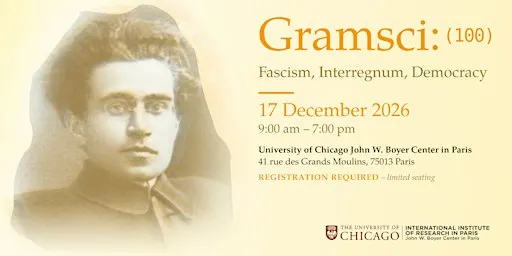
GRAMSCI 100: FASCISM, INTERREGNUM, DEMOCRACY a lieu jeu. 17 déc. 2026 à 9:00 (GMT+1), à University of Chicago John W Boyer Center in Paris, Paris, France. Entrée gratuite; l’annonce est sur Eventbrite.
À propos de cet événement
Des chercheurs examinent le fascisme, l'intergouvernement et la démocratie dans les crises actuelles lors d'un événement à Paris le 17 décembre 2026.
Čeština · Deutsch · Español · Español · Français · Français · Italiano · 日本語 · Nederlands · Português · Português
Description complète de l’organisateurAfficher moins
A century after Gramsci’s arrest, scholars examine fascism, interregnum and democracy in today’s crises. Paris, 17 Dec 2026. In Autumn 1926, Antonio Gramsci was arrested by Italian Fascist authorities in Rome. He would spend the next decade of his life — until his untimely death in April 1937 — behind bars, composing the texts posthumously published as his celebrated Prison Notebooks. On December 17, 2026, we mark the centenary of Gramsci’s arrest by bringing together scholars of his life and work to examine the enduring legacy of his thought in light of contemporary crises of the liberal-capitalist order. Across many regions of the world, existing institutions are under strain, authoritarian movements are gaining traction, and epochal economic developments threaten to intensify social inequalities while deepening conditions of political anomie and fragmentation. In this context, a return to Gramsci’s work can help orient critical thought and stimulate efforts to envision alternative paths forward. Gramsci 100: Fascism, Interregnum, Democracy takes up this task by thematizing three distinct yet interrelated objects central to Gramsci’s oeuvre: Fascism. One of Gramsci’s signal contributions to social theory was to develop a layered analysis of fascism as a mass political phenomenon rooted in social dislocation, institutional erosion, and hegemonic crisis. This panel will revisit Gramsci’s interpretation to consider its implications for current efforts to understand authoritarian and anti-democratic movements. Themes include the allure of nationalism, the social composition of right-wing movements, and the contested afterlives of Gramsci’s own thought, including its appropriation and reinterpretation within contemporary far-right milieux. Interregnum. Among Gramsci’s most evocative concepts, the “interregnum” describes a period in which established social orders lose their authority while alternatives are struggling to emerge. In his Prison Notebooks, Gramsci famously characterized such moments as times when “the old is dying and the new cannot be born,” a situation engendering instability, intense political and ideological contestation, as well as experimentation and, at times, surprising openings for the construction of emancipatory alternatives. This panel will examine Gramsci’s understanding of historical crisis, temporality, “in-betweenness,” and the plural possibilities opened by moments of fragmentation and transition. Democracy. Gramsci’s reflections on democracy extended beyond state institutions to encompass workers’ councils, mass parties, grassroots mobilizations, and experimental efforts at building a democratic politics “from below.” This panel takes up his contributions to democratic theory, including questions of political organization, popular agency, and the conditions under which democratic capacities can be built, consolidated, and sustained. Particular attention will be paid to Gramsci’s influence on contemporary debates surrounding populism, including his central role in shaping theoretical discussions of popular sovereignty, institution-building, and radical democratic strategy. Presenters include Panagiotis Sotiris (University of the Aegean), Camila Vergara, John Chalcraft (London School of Economics), Natasha Piano (UCLA), Lynda Dematteo (EHESS), and Alastair Davidson, among others. A detailed program can be found here. Gramsci 100 has been made possible by generous sponsorship from the University of Chicago’s International Institute for Research in Paris (IIRP). The primary working language of the conference will be English.
Poursuivre
Tous les événements à Paris →Événements similaires
Tout voir →





Détails
- Quand
- jeu. 17 déc. 2026 · 9:00 (GMT+1)
- Où
- University of Chicago John W Boyer Center in Paris
- Adresse
- 41 Rue des Grands Moulins, 75013 Paris
- Prix
- Gratuit
- Genre
- 112/conference
Questions
- Quand a lieu GRAMSCI 100: FASCISM, INTERREGNUM, DEMOCRACY ?
- jeu. 17 déc. 2026 à 9:00 GMT+1.
- Combien coûtent les billets pour GRAMSCI 100: FASCISM, INTERREGNUM, DEMOCRACY ?
- Entrée gratuite.
- Où a lieu GRAMSCI 100: FASCISM, INTERREGNUM, DEMOCRACY ?
- University of Chicago John W Boyer Center in Paris, 41 Rue des Grands Moulins, 75013 Paris, Paris, France.
- Où acheter des billets pour GRAMSCI 100: FASCISM, INTERREGNUM, DEMOCRACY ?
- Les billets sont vendus sur Eventbrite. Cette page renvoie directement à cette annonce; aucun billet n’est vendu ici.